

Maine Artists Are Taking Their Legacies Into Their Own Hands
Hallam and Smart were far ahead of the trend. Although the residency program didn’t begin operating until this fall, they created the Surf Point Foundation in 1988 with a vision of transforming their 6,000-square-foot seaside home and surrounding 44 acres into a residency for artists, art historians, architects, critics and designers after they were gone.

A painting of artist Beverly Hallam, left, and arts supporter Mary-Leigh Call Smart by Grant Drumheller hangs on the wall in the entrance area of the Surf Point Foundation in York. Gregory Rec/Staff Photographer
By Bob Keyes Staff Writer - Portland Press Herald
YORK — Shiao-Ping Wang felt the presence of Beverly Hallam when she spent three weeks in the late artist’s studio this past fall.
Wang, a painter from Somersworth, New Hampshire, was among the first artists to participate in a new residency program of the Surf Point Foundation of York, which offers artists the opportunity to live in the modernist home that Hallam helped design with her companion, the art patron Mary-Leigh Smart. Before they died, they created the foundation to ensure the home they shared for more than 40 years would remain a place where artists would make art and where their spirit for adventure would survive.
It’s an idyllic setting, close to the pounding surf on one side and abutting the Rachel Carson Wildlife Refuge on another. “I really feel like I am reliving Beverly Hallam’s life,” Wang said, standing in the light of Hallam’s studio, with its vaulted ceiling and massive walls that accommodate large-scale paintings. “It’s a very emotional, psychological and artistic thing. Every time I go to a new spot and experience something, I think, ‘This is how it feels, how she felt, how they felt——this is a life in the arts. It’s a most significant experience.”
For Wang, that meant the best studio she’s ever worked in, with three weeks to experiment and create——and fresh meals daily.

Photo by Heather Henriksen, courtesy of Surf Point Foundation
Artist-endowed foundation in Maine, and their market values:
Dorothea and Leo Rabkin Foundation, $18,882,951
The Bob Crewe Foundation,
$11,527,042
Ellis-Beauregard Foundation,
$10,208,346
Surf Point Foundation,
$9,618,055
Anonimo Foundation (John David Ellis and Joan Beauregard), $9,272,361
Star of Hope Foundation
(Robert Indiana), $5,224,227; artist’s estate not yet settled, not fully endowed
Kenneth Noland Foundation,
$5,084,360; not fully endowed
Falcon Charitable Foundation (Joseph Fiore), $4,333,943
Heliker-LaHotan Foundation,
$1,605,094
Will and Elena Barnet Foundation Inc., $1,225,662
Carlo Pittore Foundation, now International Artists Manifest, $565,292
Joseph and Mary Fiore Family Foundation, $414,945
Acadia Foundation, Richard Estes: $618; this is a living artist’s foundation, not yet endowed
John Marin Foundation, $0; this is a living donor’s foundation, not endowed
Sources: Guidestar and the Aspen Institute
Surf Point is the latest artist-endowed foundation to begin operating in Maine, where there are more per capita private foundations created by an artist, the artist’s family or a beneficiary than in any other state, indications both of Maine’s longstanding calling as a place to make art and its population’s status as the oldest in the country. Simply put, a lot of artists live and die in Maine, and when they die, they leave their art and legacies behind. By creating foundations while they are alive, artists have a hand in shaping their own legacy while also leaving something behind for other artists and the public.
According to the Aspen Institute, a Washington, D.C.-based think tank that has conducted the most research on the topic, Maine has at least 14 artist-endowed foundations at various stages of activity, with a cumulative value of $78 million. Of those, the Dorothea and Leo Rabkin Foundation of Portland is the largest, with assets of nearly $19 million, according to the latest available tax data. Other large artist foundations in Maine are the Bob Crewe Foundation in Portland with $11.5 million in assets, the Ellis-Beauregard Foundation of Rockland with more than $10 million in assets, and Surf Point, valued at $9.6 million.
Depending on the settlement of the estate of the late artist Robert Indiana of Vinalhaven, his Star of Hope Foundation could become Maine’s largest. Indiana’s estate, which will fund the foundation, is estimated at more than $100 million, but is tied to ongoing litigation.
Although there’s never been a reliable census of Maine artists, by the best estimate of people active in the field, there are probably between 1,000 and 2,000 other artists in a state without the resources to establish a foundation,
who have spent their lives making art and will have little to show for their exhaustive efforts after they die——a cause that has become something of a crusade for Sarah Bouchard, executive director of International Artists Manifest, a nonprofit arts organization with the mission of taking on and caring for the works of underrepresented artists after they die. Bouchard co-founded the Woolwich-based organization in 2012, with the gift of the assets of the artist-endowed Carlo Pittore Foundation, where she previously worked but which failed, then dissolved.
It upsets Bouchard to consider the number of artists who spend their lives making and showing their art, “and then usually they die and no one will ever know about their work. It will go to their kids, it will end up in a dumpster,” she said. “I get emotionally disturbed when I think about how many artists that happens to, and not only because of the artist and the loss for them, but for us. … They have spent their whole life creating this work and then it’s just gone, so we as a culture lose this massive resource. It’s so devastating.”

Artist Jibade-Khalil Huffman works in a studio space at the Surf Point Foundation in York.
Gregory Rec/Staff Photographer
A Growing Trend
The increase in the number of foundations and other organizations addressing artists and their legacies reflects a national trend, said Christine Vincent, project director of the Artist-Endowed Foundations Initiative of the Aspen Institute. There are 433 artist-endowed foundations nationally, and 40 percent were created in the past 15 years. Most of the foundations in Maine were created during that time.
Hallam and Smart were far ahead of the trend. Although the residency program didn’t begin operating until this fall, they created the Surf Point Foundation in 1988 with a vision of transforming their 6,000-square-foot seaside home and surrounding 44 acres into a residency for artists, art historians, architects, critics and designers after they were gone. Hallam died in 2013, and Smart in 2017.
The Aspen Institute released its first report on the artist-endowed foundation trend in 2010, and has updated it twice. Nationally, the value of artist-endowed foundation assets more than doubled from 2011 to 2015, rising 120 percent to $7.66 billion. By comparison, among all foundations nationally, asset value rose 40 percent, said Vincent, the former president of Maine College of Art and a past deputy director at the Ford Foundation, who lives on Vinalhaven.
Giving by artist-endowed foundations is up, as well, and those grant-making activities are “squarely on the arts,” Vincent said, with 79 percent of giving among artist-endowed foundations going to the arts and artists.
The reasons for the growth are simple, Vincent said: demographic trends in the artist population, the rise of the global art market and the desire of artists to provide for their creative works and philanthropic interests in the long term. Maine has a lot of artist-endowed foundations relative to its population because a lot of artists live here, she said.
Living Maine artists have directly benefited from the growth in the foundations and their assets, as more foundations have begun awarding high-dollar individual grants and creating residency opportunities, such as at Surf Point, which has awarded three-week residencies to 10 artists since October. Surf Point expects to award a total of 30 residencies in its first year.
Since December, the Ellis-Beauregard Foundation has given $80,000 directly to artists in various fields – $25,000 to Lewiston painter Reggie Burrows Hodges for its annual Fellowship in the Visual Arts, which it has awarded for three years and comes with the promise of an exhibition at the Center for Maine Contemporary Art; $20,000 to Minnesota composer Reinaldo Moya, who will use the money to write music for the Bangor Symphony Orchestra; and another $35,000 in project and travel grants to Maine artists, in increments of $2,000 and $5,000.
The Rabkin Foundation, founded and named by an artist and his wife who spent their lives in New York, has given away $1.2 million to 24 arts writers across the country since 2017, and plans to distribute another $400,000 this summer – $50,000 grants to another eight writers. (Disclosure: This reporter was a recipient of a Rabkin Prize in 2017). It also awarded $50,000 to New York Times art critic Roberta Smith for lifetime achievement and gives away $25,000 annually for research and writing in the area of the American folk and outsider art, which was a collecting interest of Dorothea and Leo Rabkin. In Maine, it has given money to a range of art organizations, including the Chart, Union of Maine Visual Artists, Spindleworks, Indigo Arts Alliance and Creative Portland. It also paid for classroom supplies for nine Portland public high school art teachers.
“The sum total of us all is and will be staggering, especially when Robert Indiana’s foundation deploys in the future,” said Susan Larsen, executive director of the Rabkin Foundation.
Indiana, best known for his iconic “LOVE” image, established the Star of Hope Foundation while he was alive. The name refers to his longtime home on Vinalhaven, where he moved from New York in search of isolation. Indiana died there in May 2018 at age 89. At this time, the foundation is valued at $5.2 million, according to figures provided by the Aspen Institute, but that number is expected to soar when the estate is settled and the foundation fully funded.
Champions of Legacies
But most artists drawn to Maine won’t leave people fighting in court over their work in their wake. Josefina Auslender arrived in Maine in 1986 from Argentina, determined to make a life in America with her husband. A product of the fine-art educational system of her home country, Auslender, 85, is known for meticulous, layered drawings. About 15 years ago, she began thinking about what would happen to her drawings after she died. Those questions became urgent two years ago when her husband did.

Artist Josefina Auslender, 85, in her studio at her home in Cape Elizabeth on Saturday. Auslender, who is originally from Argentina, has had a long, successful career and is working with a Maine group, the International Artists Manifest, to preserve her artistic legacy after she dies. Brianna Soukup/Staff Photographer
She began getting answers when a mutual friend introduced her to Bouchard at an art opening at Corey Daniels Gallery in Wells. Bouchard began working on artist legacies in 2007 when she became involved with the Carlo Pittore Foundation. Pittore, who died in 2005 and was a founder of the Union of Maine Visual Artists, had set aside money for a foundation in his name, but the foundation crumbled when the stock market crashed in 2008. “We lost everything, almost,” Bouchard said.
What was left was used to establish International Artists Manifest, which became a nonprofit in 2014. Pittore was the first artist the organization worked with, and Auslender, of Cape Elizabeth, is the second.
In November, the International Artists Manifest sent out its first fundraising appeal and is actively trying to raise its profile and expand its work, Bouchard said.
Its goal is to champion the legacies of artists. That means documenting their works and creating a digital archive, placing art in exhibitions, selling art and generally promoting the artist. In Auslender’s case, International Artists Manifest is also making a documentary about her, working with Maine-based filmmaker Reginald Groff to tell her story. The organization may also produce a catalog of her work.

Sarah Bouchard, right, executive director of International Artists Manifest, combs through the collection of the late artist Carlo Pittore with art appraiser Zak Vreeland in a storage unit at Fort Andross Mill. Ben McCanna/Staff Photographer
Auslender also hopes to create a grant program to benefit artists who are coming out of art school and seeking their first exhibitions. As a young artist in Argentina, she benefited from mentors, and also had support from other artists and curators when she began establishing her artistic profile in America. “The beginning is so difficult for artists,” Auslender said.
She has agreed to give International Artists Manifest most of her art and her archives. The details of the arrangement are still being negotiated by her family and her attorney, she said.
Auslender opted to work with International Artists Manifest so she would not be a burden to her children. “I have two sons, and they could take care of my work. But they are busypeople,” she said. “One is a doctor here in the United States, and he is very, very busy. The other lives in Germany, and he himself is an artist. He said to me, ‘I am interested in having three or four of your works, but I have thousands of my own.’ I said, ‘Of course.’ ”
Knowing that her art will be cared for and that someone will work to promote it after she dies gives her peace of mind, she said. “They are going to keep my work above the surface. It’s going to a place where it is going to be taken care of,” she said. “This is something I never thought would happen to me. These are things happening to Andy Warhol or (Robert) Rauschenberg, not to me.”
Kent Gordon worked with Bouchard to begin International Artists Manifest. He was a longtime friend of Pittore’s, working with him when Pittore focused on reviving the Union of Maine Visual Artists in the late 1980s.
He was distraught when the foundation faltered, and decided to get involved. “It looked like his attempt to preserve his legacy was going to fail and all his works would end up in a fire sale. I just didn’t want to see that happen, and saw a way to do something about it, not only as a way to help Carlo but other artists who found themselves in a similar situation,” Gordon said.
It took several years to complete the paperwork to dissolve the foundation, which drew its assets from Pittore’s estate, and form a distinct nonprofit organization, which can raise money from multiple sources. The Aspen Institute defines an artist-endowed foundation as one created by an artist, family member or beneficiary that is dedicated to promoting the artist and his or her work for the public benefit. In Maine, a number of public charities, including museums, colleges and land trusts, have received artist bequests, and those don’t count.
“The concept of the whole organization is that it could be, and hopefully it will be, somewhat self-funding in the sense that we’re committed to maintaining a digital archive of an artist’s work, but fund the whole effort by selling some of their actual work,” Gordon said. “To make this work, we have to get a few artists whose estates are worth more than what it takes to preserve them. That way, they can also help other artists, which seems like to me something artists would consider a good idea.”
At this time, the International Artists Manifest is working with an annual operating budget of $65,000. “Ideally, if we had a $3 million endowment, it could run at $150,000 a year. That would be beautiful,” Bouchard said. “We need to find donors who understand the actual problem and that it’s massive.”
Continued Spirit
While many of the foundations in Maine are thriving, the Heliker-LaHotan Foundation is at what its executive director calls “an awkward moment.” The foundation, formed by the artists John Heliker and Robert LaHotan of New York and Maine, is in the process of dissolving because of a lack of operating funds, said executive director Patricia Bailey. The foundation has offered residencies for painters and sculptors at the artists’ home on Great Cranberry Island since 2006, and hosted 146 residents in 14 years. The four-acre campus on the Pool, a small inlet of Great Cranberry, includes a main house and three studio buildings.
The foundation sold a small parcel of land to fund itself through 2019, and is trying to figure out the next step. “There was never a large sum of money to sustain us, and quite frankly we have lasted much longer than we ever expected to,” Bailey wrote in an email.
“I think it would be acceptable to say that our board would consider a donation of the historic campus, which for almost 50 years was Heliker and LaHotan’s painting headquarters, to another not-for-profit institution with the essential resources to continue the spirit of that kind of philanthropic arts use our founders intended.”
Despite winding down operations, Bailey said the foundation accomplished its goal of giving artists a place to create new work while promoting the art and lives of Heliker and LaHotan.
“As to legacy, it is of course both tangible and intangible. Many national, international and Maine artists spent a month on an island in Maine, not as tourists but living and working as part of the community. It would not be an exaggeration to say that some of them feel their lives and work were changed forever because of that experience,” she wrote.

Mary-Leigh Smart and Beverly Hallam at home at Surf Point. Photo courtesy of Surf Point Foundation
The ability to offer similar life-changing experiences motivated Hallam and Smart to identify their home as a place where art could be made long after they died, said Yael Reinharz, executive director of Surf Point. They placed a conservation easement on the land in 2007 to restrict development for the same reasons they formed the foundation, with a mind to their own lives and legacies and the future of their home and land.

Yael Reinharz Photo by Gillian Laub, courtesy Surf Point Foundation
They were pioneering women in the arts, and each was active in that world in her own way. Smart was a patron and collector, and affiliated with the Barn Gallery in Ogunquit and the major museums across Maine. Hallam moved to Maine in the early 1960s after teaching at Massachusetts College of Art. She was among the first artists to experiment with acrylics, and became a master of the medium. While the Surf Point Foundation holds the bulk of her archives, much of it is housed within the Smithsonian Archives of American Art, and her life and work were the subject of a movie and book. Smart and Hallam designed their home as an embodiment of their love of the arts, the environment and the confluence of both.
Every room but one has a view of the water, and that room they used as a gallery. All the interior space was designed to accommodate large paintings or sculpture, and books, magazines, musical records and other items. Surf Point has updated the house to meet safety codes, but otherwise has kept most everything intact.

Artist Kathleen Kolb of Vermont works in the Pool Room, with expansive views of the ocean at the Surf Point Foundation in York. The foundation and its new residency program were the vision of artist Beverly Hallam and arts supporter Mary-Leigh Call Smart and are based in the modern-style home on the coast of York that the women designed and had built in 1971. The space that Kolb is working in used to be the studio space for Hallam. The home has space for three artists for each residency period, which last three weeks. Gregory Rec/Staff Photographer
Bryan Graf, a photographer from Portland, felt intimated by the scope of the ocean when he arrived at Surf Point for his residency in the fall. He was assigned the Pool Room as his bedroom and studio, so named because of the long-ago presence of an indoor pool, now covered with flooring. The focal point of the room is a wall-length expanse of glass windows and doors, opening to the ocean that’s about 25 feet away.
Graf lives two blocks from the ocean in Portland, but had never experienced water like this. “This is a different animal,” he said, facing the ocean from the behind the glass. “I can hear it, I can see it and I can smell it all the time.” The intimidation didn’t last. In no time, he fell into the rhythm of the ocean and began making art.
www.pressherald.com/2020/01/19/maine-artists-are-taking-their-legacies-into-their-own-hands/

Dr. Carrie Cushman - December, 2019
Dr. Carrie Cushman joins Surf Point for a residency during the third week of December. Carrie joined the Davis Museum at Wellesley College in September of 2018 for a three-year term appointment as the Linda Wyatt Gruber '66 Curatorial Fellow in Photography.
“Time seems to grow at Surf Point. Everyday there was rich in productivity, contemplation, and personal and professional growth.”
Dr. Carrie Cushman joins Surf Point for a residency during the third week of December. Carrie joined the Davis Museum at Wellesley College in September of 2018 for a three-year term appointment as the Linda Wyatt Gruber '66 Curatorial Fellow in Photography. She has a Ph.D. in art history from Columbia University and is a specialist in the history of photography in Japan. Her dissertation is titled "Temporary Ruins: Miyamoto Ryuji's Architectural Photography in Postmodern Japan." As the Gruber Fellow, Carrie is responsible for teaching and curating with the Davis Museum's permanent holdings in photography, collaborating with faculty across disciplines, and curating special exhibitions. In fall 2018, she organized the exhibition Bread and Roses: The Social Documentary of Milton and Anne Rogovin, to highlight a recent gift to the Davis of 250 vintage prints by Milton Rogovin; for fall 2019, she curated Recent Acquisitions: New Photographs, featuring the work of Haley Morris-Cafiero and Habiba Nowrose, two emerging female photographers Cushman brought into the Davis holdings. For spring 2020, she will realize two ambitious and conceptually conjoined exhibitions. Making, Not Taking: Portrait Photography in the 19th Century recreates the environment of a nineteenth-century portrait studio amidst selections from the Davis’s collection of daguerreotypes, ambrotypes, cartes de visite, cabinet cards, and tintypes.


photo: https://academies.hypotheses.org/


Elaine K. Ng - December, 2019
Elaine K. Ng explores the physical and psychological structures of site. Her multi-disciplinary practice uses material investigation, writing, and research to examine collective knowledge of place.
“I loved my studio space and its glorious view of the ocean and surf. Being able to watch the surf come in and the weather change each day - you would think this would be unproductive, but actually it gave me the peaceful and expansive mental space I needed to work. Surf Point has all the makings for an exceptional residency program: a legacy specifically in support of the artistic process, an intangible spirit of place, and a generous and supportive staff and organization. What more could an artist ask for?”
Elaine K. Ng explores the physical and psychological structures of site. Her multi-disciplinary practice uses material investigation, writing, and research to examine collective knowledge of place. It manifests as installations and sculptural objects that are often poetic in sensibility and play off the architecture of a space. Her most recent work has been focused on the patterns and materials that help define place and our relationship to it. Born in Dallas, Texas to immigrants, Elaine first trained as a classical musician and then studied pre-veterinary medicine and ceramics at the University of California, Davis. She went on to obtain an MBA and an MA in Arts Administration from Southern Methodist University. After a 10-year career in nonprofit management, she returned to the studio to focus on her own artwork and completed her MFA from Cranbrook Academy of Art in 2014. She exhibits internationally, has been a Visiting Professor at NSCAD University and a Visiting Artist at Tainan National University of the Arts, and has lectured at the China Academy of Art in Hangzhou, China. She is a 2019 Artist in Residence at the Djerassi Resident Artist Program and a 2019-20 Research Fellow with the Winterthur Museum, Garden and Library, and was recently named the Maine Arts Commission’s Visual Artist Fellow for 2020. In 2017-18, Elaine was awarded a U.S. Fulbright Fellowship for research in Taiwan. Elaine is currently showing work in a group exhibition at Able Baker in Portland.

101 Guohoa Street, Section 2
More of his work can be seen at www.elainekng.com.

Daniel AnTon Johnson - December, 2019
Daniel AnTon Johnson is an artist with a diverse practice based in photography, language, film, and video. His work examines how technology shapes notions of identity within popular culture and contemporary visual media.
“Between the house, the views, and the community, there's something really special about Surf Point.”
Daniel AnTon Johnson is an artist with a diverse practice based in photography, language, film, and video. His work examines how technology shapes notions of identity within popular culture and contemporary visual media. Focusing on authorship and representation, Johnson’s practice explores cultural and visual literacies and how they form worldviews. He has shown nationally and internationally in group exhibitions and video festivals in New York, Los Angeles, Tokyo (JP), Berlin (DE), Tel Aviv (IL), and Bratislava (SK), among others. Johnson has taught and lectured at School of Visual Arts, Adelphi University, Rutgers University-Newark, and Columbia University, and mentored teens at ICP and The Harlem School of the Arts. Johnson holds an MFA in Photography, Video and Related Media from the School of Visual Arts, and an MA in English from Washington College. He currently resides in Brooklyn.

BARRACK OBAMAS: I FEEL BLACKEST AGAINST #FFFFFF
More of his work can be seen at danieljohnson.net.

Anna Hepler - December, 2019
Anna Hepler is a sculptor based in Greenfield, MA. She comes from a family of botanists and beekeepers who structured their lives around the unpredictable movements and challenges of the natural world.
“I dove into a state of full immersion in the studio, and was held there by the relentless pounding waves (the drum beat of the Atlantic edge), savoring the chance to focus without interruption, and cared for in such a way that risk taking became inevitable.”
Anna Hepler is a sculptor based in Greenfield, MA. She comes from a family of botanists and beekeepers who structured their lives around the unpredictable movements and challenges of the natural world. This life, collaborating explicitly with forces beyond one’s control, establishes a dynamic of flexibility and acceptance, or respect for the unknown. It is this same dynamic that drives and guides her work. Though she has been based in New England for several decades, she has also spent fruitful periods in Seoul, South Korea, in the Netherlands, Italy, and Cyprus, and within the US on both coasts, in cities, in the desert, and in the mountains. Living within unfamiliar cultures, surrounded by the sounds of different languages, and in varied landscapes, she learns to let go of knowing, understanding, and controlling her experience.

The Referee, 2017, plywood, paint, ink, 8 x 6 x 4 feet
Hepler earned a B.A. from Oberlin College and an M.F.A. from the University of Wisconsin-Madison. A former Henry Luce Foundation fellow in Seoul, South Korea, she has completed residencies at the Roswell Artist-in-Residence Program, the Tamarind Institute, the Nova Scotia College of Art and Design, and the Archie Bray Foundation. In 2016 she was awarded a fellowship by United States Artists, a grant from the Harpo Foundation in 2018, and most recently a Nancy Graves Foundation grant. Hepler has exhibited widely, and her work can be found in the collections of the National Gallery of Art in Washington, D.C., the Tate Modern in London, and the Portland Museum of Art in Maine.
More of her work can be seen at www.annahepler.com.

Kathleen Kolb - November, 2019
Kathleen Kolb is interested in the action and meaning of visual light on everyday surroundings and in the intersection of emotional experience with what we see.
“My residency at Surf Point gave me solid, expansive, productive, creative time in an elemental setting that grounded the work. The other residents enriched my experience, broadening my mind, and my network. In three short weeks I came away with finished work for exhibition, and new peers I look forward to maintaining connections with.”
Kathleen Kolb is interested in the action and meaning of visual light on everyday surroundings and in the intersection of emotional experience with what we see. As a painter, her work is based in observation. The primary theme in all her work is light. In addition to light, her work is about attachment and place. She is drawn to rural landscape and to the formal qualities of the geometry of traditional New England architecture, looking for inspiration in rural landscape, wilderness, and small town New England. Her aim is to evoke a time and place in our shared world, and a corresponding emotional experience. Her method is to spend time paying acute attention. She searches out subjects that are visually arresting and that evoke riveting emotional energy.

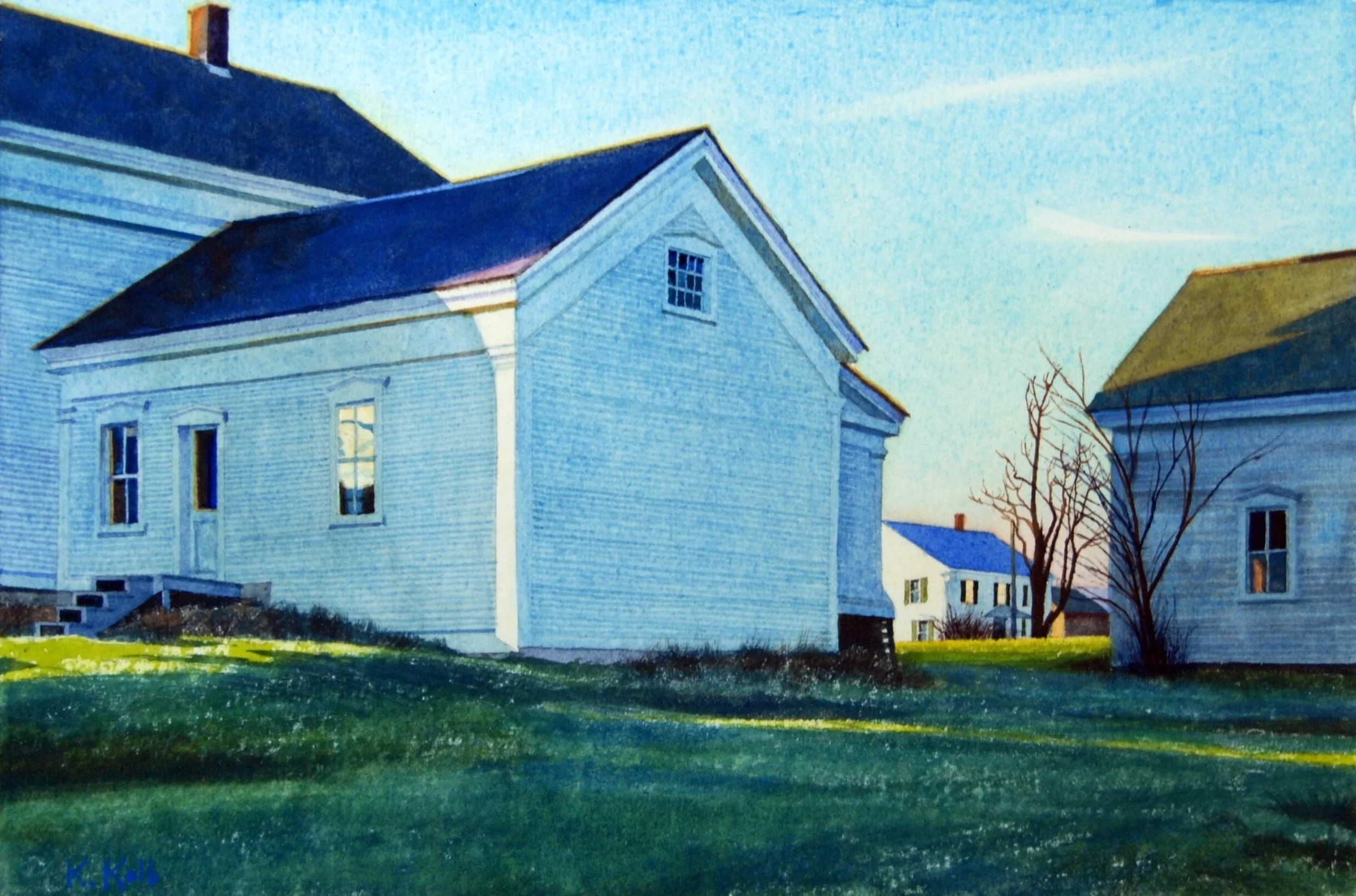
Back Steps - 2012
More of her work can be seen at www.kathleenkolb.com.

Jibade-Khalil Huffman - November, 2019
Jibade-Khalil Huffman’s practice encompasses writing, image making and where these two meet somewhere in the middle.
“Surf Point was a game changer for me in terms of time and space to finish a long in the works piece as well and refocus moving forward. I feel lucky to have had the opportunity.”
Jibade-Khalil Huffman’s practice encompasses writing, image making and where these two meet somewhere in the middle. In 2008, he published his first book, "19 Names For Our Band,” and has continued working in this fashion--making books of poems, up to and including the more recent, “Sleeper Hold” (2015). Currently he is working on a book of essays (about hip-hop, cinema and art to be published in 2020) that double as, or veer into, poetry. His visual practice spans photography, video and sculpture. More recently, he has been making multi-layered light boxes. These works distill many of his interests: layering, the juxtaposition of text and image and the sculptural use of images.


He is also very interested in appropriation and making work that is reflective of image overload and generative in its own use of medium and message. Finally, all or much of the above intersects in installation, performance and interventions combining site, text and experience. In performance, as in his videos, he typically works with performers though occasionally uses his own body in various investigations of African-American masculinity. While his performances typically make use of a singular voice, performing a text, addressing an audience, the installations utilize multiple projections and overlapping soundtracks that surround viewers to suggest a complicity in this spectatorship.
More of his work can be seen at anatebgi.com/cpt_artists/jibade-khalil-huffman.

Cynthia Barton - November, 2019
Cynthia Barton makes both policy and textiles. She is trained as an architect, and much of her work deals with post-disaster housing and community recovery.
“My time at Surf Point enabled me to do some of the most focused, intense work of my career. It was a privilege to have the company of excellent new colleagues, and inspiring to have the ocean nearly part of my studio.”
Cynthia Barton makes both policy and textiles. She is trained as an architect, and much of her work deals with post-disaster housing and community recovery. She works on textile projects for the same reason she is interested in climate change resilience: the problems are difficult. Whether the constraints are political or material, they require going forward in uncertain conditions, improvisation, and patience. As an artist, she engages questions of displacement, of what it means to lose one’s home in the larger sense, and how one regains a place in the world. For over a decade, she has been deeply invested in the study of textiles and embroidery, art forms found in the most provisional circumstances. In both practices, she is interested in fitting the resources at hand to unintended purposes. Using well-worn fabrics, she makes talismans that bring comfort and pleasure, and are inevitably linked to vulnerability. As soft objects that can wrap the body, textiles offer a unique and intimate form of relief from crisis. Her pieces to date have all been dedicated to specific people at moments of dramatic change in their lives. In many ways they provide both refuge from and connection to the environment.

More of her work can be seen at cynthia-barton-textiles.squarespace.com.

ShiaoPing Wang - October, 2019
ShiaoPing Wang immigrated from Taiwan and has a MFA from Queens College, City University of New York. Using various painting media, Wang aims to invent her own language from different cultures to bridge intuition and knowledge.
ShiaoPing Wang immigrated from Taiwan and has a MFA from Queens College, City University of New York. Using various painting media, Wang aims to invent her own language from different cultures to bridge intuition and knowledge. Her paintings have been exhibited widely in the US, Europe and China. She has received many awards and has taken part in residencies in the US, France, Spain, and Canada. Wang works at her studio in Rollinsford, NH, and is represented by the Furchgott Soudiff Gallery, VT, the Barn Gallery and George Marshall Store Gallery, both in Maine.

More of her work can be seen at Shiao-Ping.com.

Caleb Cole - October, 2019
Born in Indianapolis, Caleb Cole is a former altar server, scout, and 4-H Grand Champion in Gift Wrapping. Their work addresses themes such as belonging and loneliness, unrealized desires, and imagined queer histories and futures.
Born in Indianapolis, Caleb Cole is a former altar server, scout, and 4-H Grand Champion in Gift Wrapping. Their work addresses themes such as belonging and loneliness, unrealized desires, and imagined queer histories and futures. They are a 2015 Massachusetts Cultural Council Fellow, 2013 Hearst 8x10 Biennial Winner, 3-time Magenta Foundation Flash Forward Winner, 2011 St. Botolph Club Foundation Emerging Artist Award winner, and 2009 Artadia Award winner, among others. Caleb exhibits regularly at a variety of national venues and has held solo shows in cities including Boston, New York, Chicago, and St. Louis. Their work is in the permanent collections of the Museum of Fine Arts Boston, Newport Art Museum, Davis Art Museum, Brown University Art Museum and Leslie Lohman Museum of Gay and Lesbian Art. They are represented by Gallery Kayafas, Boston.

More of his work can be seen at CalebColePhoto.com
Bryan Graf - October, 2019
Bryan Graf received an MFA from Yale University in 2008 and a BFA from the Art Institute of Boston in 2005. His work has been exhibited internationally; most recently at Atlanta Contemporary, where his solo exhibition, Landlines, is on view through December 22, 2019.
Bryan Graf received an MFA from Yale University in 2008 and a BFA from the Art Institute of Boston in 2005. His work has been exhibited internationally; most recently at Atlanta Contemporary, where his solo exhibition, Landlines, is on view through December 22, 2019. Graf was a 2016 recipient of the Pollock-Krasner Foundation Grant. His work has been featured and reviewed in numerous publications, including The New York Times, The New Yorker, Harpers, Blind Spot, Details, Fanoon Center for Printmedia Research, among others. He has published four books: Wildlife Analysis (Conveyor, 2013); Moving Across the Interior (ICA@MECA, 2014); Prismatic Tracks (Conveyor, 2014); and Debris of The Days (Conveyor 2017). His photographs and books are held in the public collections of The Museum of Modern Art, The Metropolitan Museum of Art, The Portland Museum of Art, Yale’s Beinecke Rare Book & Manuscript Library, The Victoria and Albert Museum, Harvard University, and the Tokyo Institute of Photography.

More of his work can be seen at BrianGrafStudio.com.

Daisy Nam - September 2019
Welcome to Daisy Nam, pilot curator in residence at Surf Point.
Daisy Nam comes to Surf Point Foundation as the pilot, pre-opening resident, helping to transform our beloved building from its original use as a duplex home into a cultural facility. Most recently, Daisy was Assistant Director of the Carpenter Center for the Visual Arts at Harvard University. Before then, she was Assistant Director of Public Programs at Columbia University, and Individual Development Coordinator at the Guggenheim Museum. Daisy will work on several curatorial projects while in residence at Surf Point. Welcome!
