
Shop
Merch
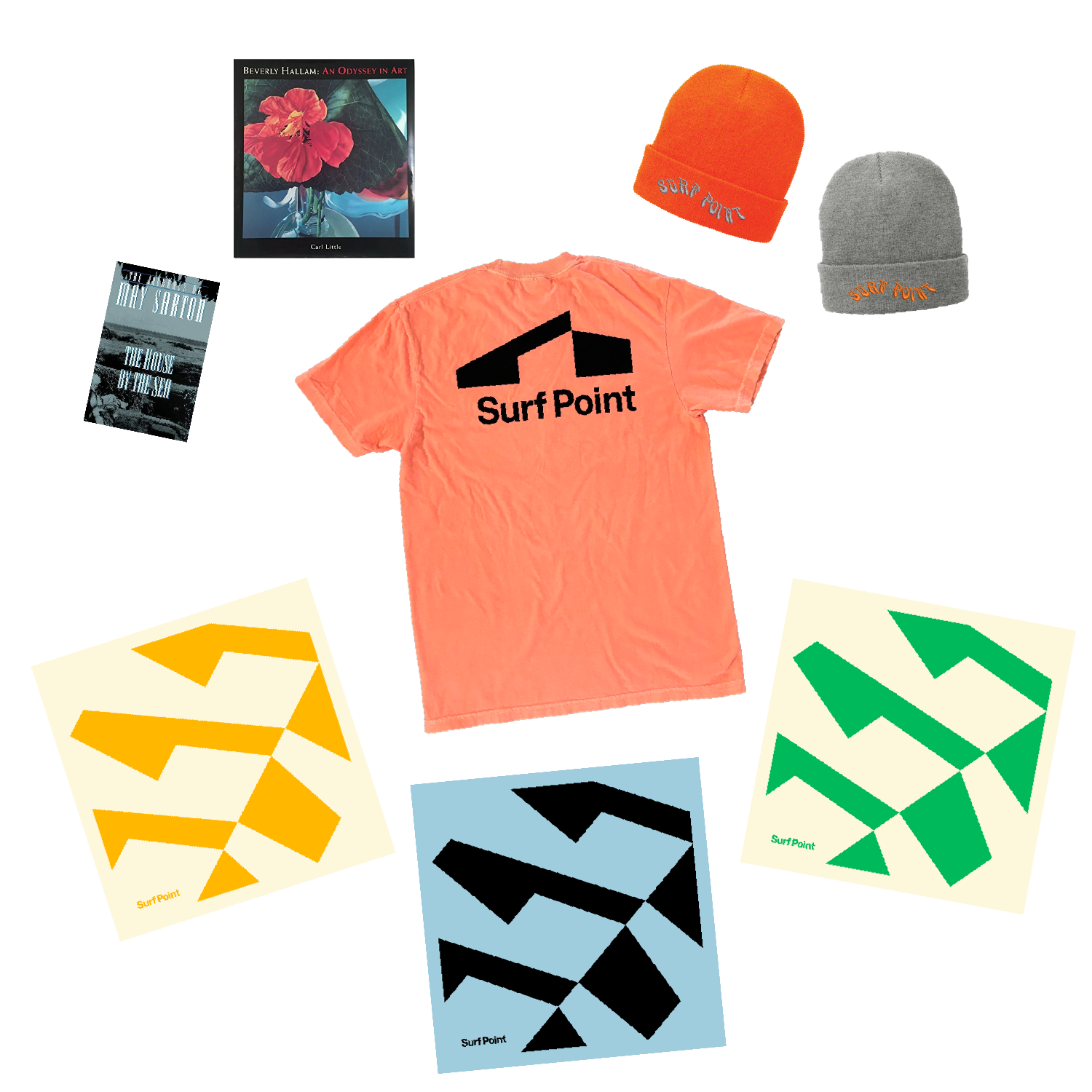
A discounted bundle of Surf Point merch including a t shirt and your choice of beanie and bandana, with the option to add a copy of "Beverly Hallam: An Odyssey in Art" by Carl Little or "The House By the Sea: A Journal" by May Sarton.
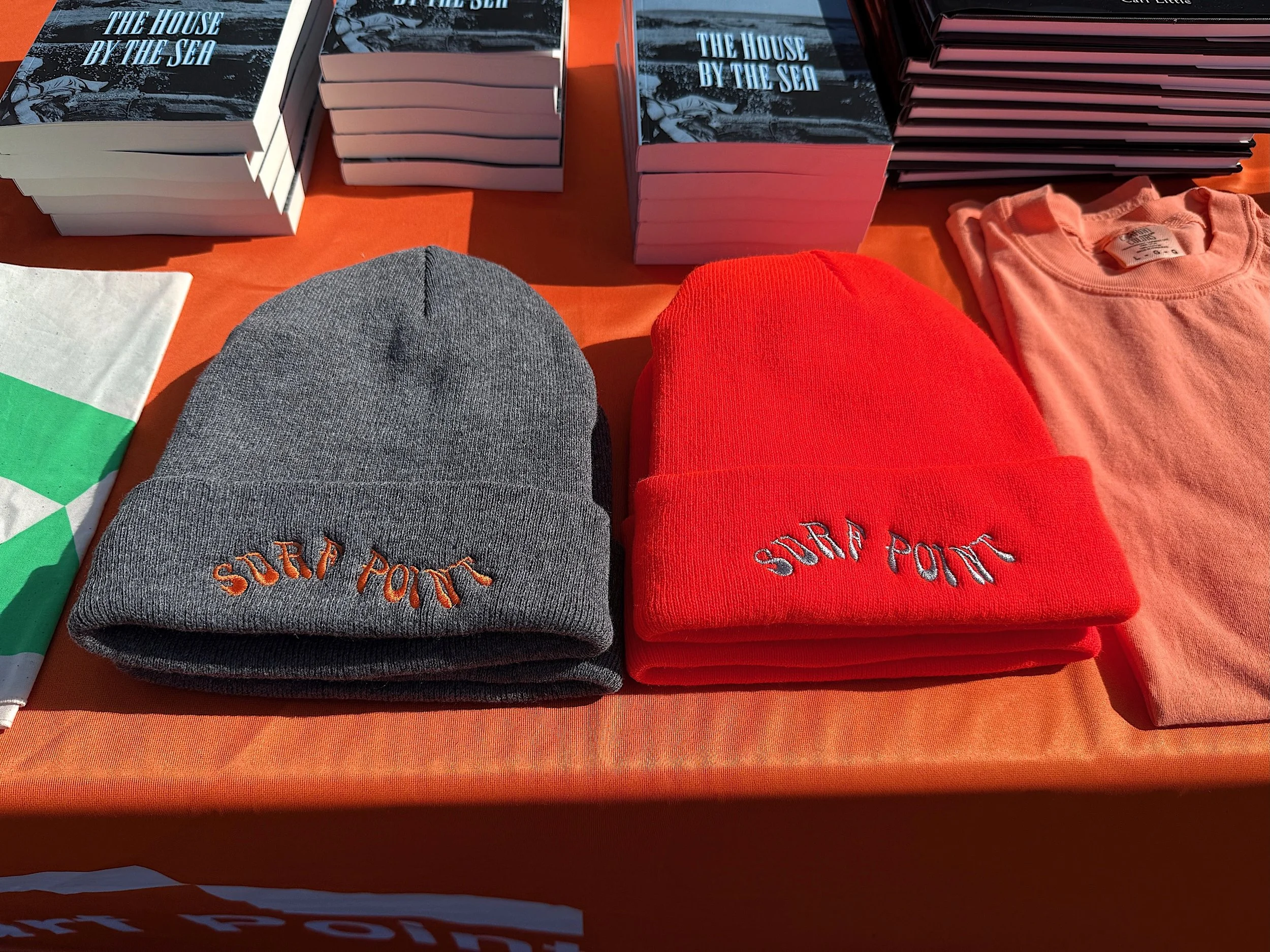
A fleece-lined beanie featuring an early Surf Point logo design by co-founder Beverly Hallam. Available in heather grey with orange text, or blaze orange with grey text.
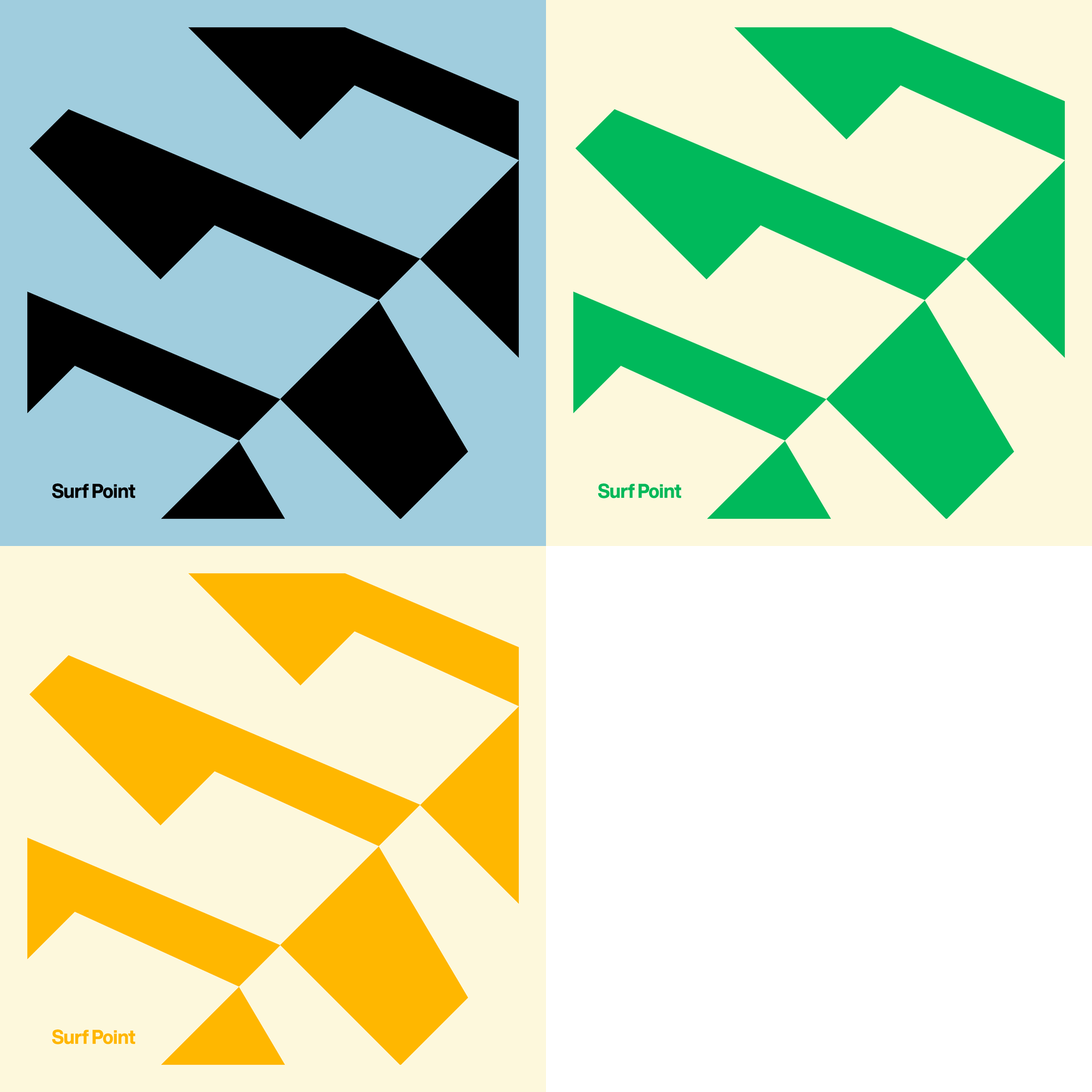
Cotton bandanas in three colorways inspired by Surf Point’s land and seascape: Ocean (blue), Garden (yellow), and Field (green). Designed by Jessie D’Amelio as a riff on our logo, this new bandana supports Surf Point’s residency, environmental stewardship, public programs, and legacy. Each bandana is $20 or get all three for $50!

Available for shipping, or arrange a pickup in Biddeford or Portland, Maine.
Books

By May Sarton. Published by W. W. Norton and Company (March 1, 1996)
This is the first journal Sarton wrote after she moved in 1973 from New Hampshire to the seacoast of Maine. Here she found the peace and aloneness she sought―and partly feared. The journal records the renewing of her life and work in this place.
–––––––––
May Sarton was arguably the first resident of Surf Point alongside Beverly Hallam. She rented the Wild Knoll House from Hallam and Mary-Leigh Call Smart from 1973-1995. The Wild Knoll Foundation Garden, started in 2021 by Carly Glovinski ‘21, was planned using “The House By the Sea” as a guide.
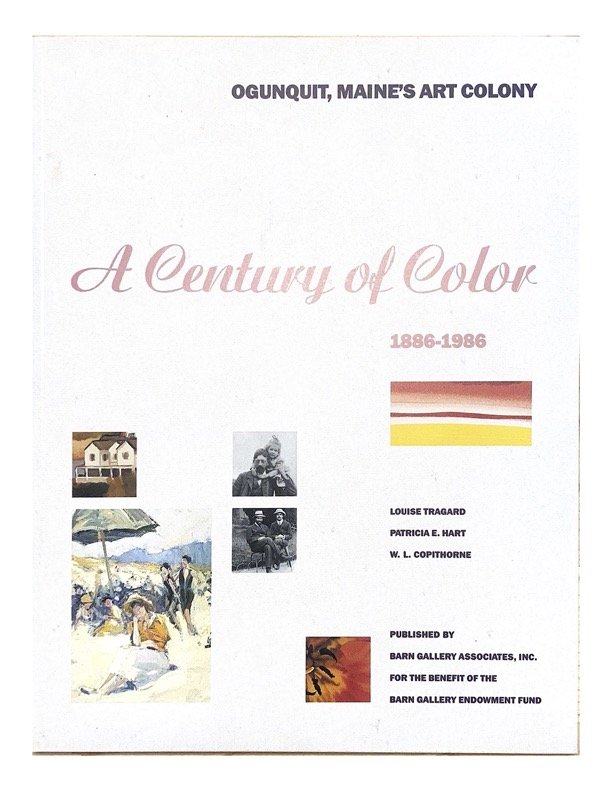
By Louise Tragard, Patricia E. Hart, and W.L. Copithorne, Published by Barn Gallery Associates, Inc., 1987. All proceeds go to Surf Point Foundation.
The authoritative text and history on this subject. Wonderful color plates, extensive index and list of artists associated with the area. Bibliography. A wonderfully arranged and present chronology and history, filled with snapshots of the people and places.

By Carl Little, Published by Down East Books, 1998. All proceeds go to Surf Point Foundation.
Beverly Hallam is an unusually gifted and productive artist. A pioneer in the use of acrylics and airbrushes, Hallam also made groundbreaking strides in monotype. She produces images that are spectacular in form, composition, and color.
Artwork

Surf Point is pleased to make available for sale from its visual archives three vintage Cibachrome prints of Queen Anne’s Lace I, which is included in the exhibition Beverly Hallam: Chasing Light. Each edition was made and signed by Beverly Hallam during her lifetime. The works are priced at $2,500, unframed.
Beverly Hallam
Queen Anne’s Lace I
10.5 x 11 in
Cibachrome
Limited edition of 20.
Editions available:
4/20
5/20
6/20
Contact us with any questions. We can arrange in-person pickup in Portland or York, Maine or ship your piece for an additional fee.
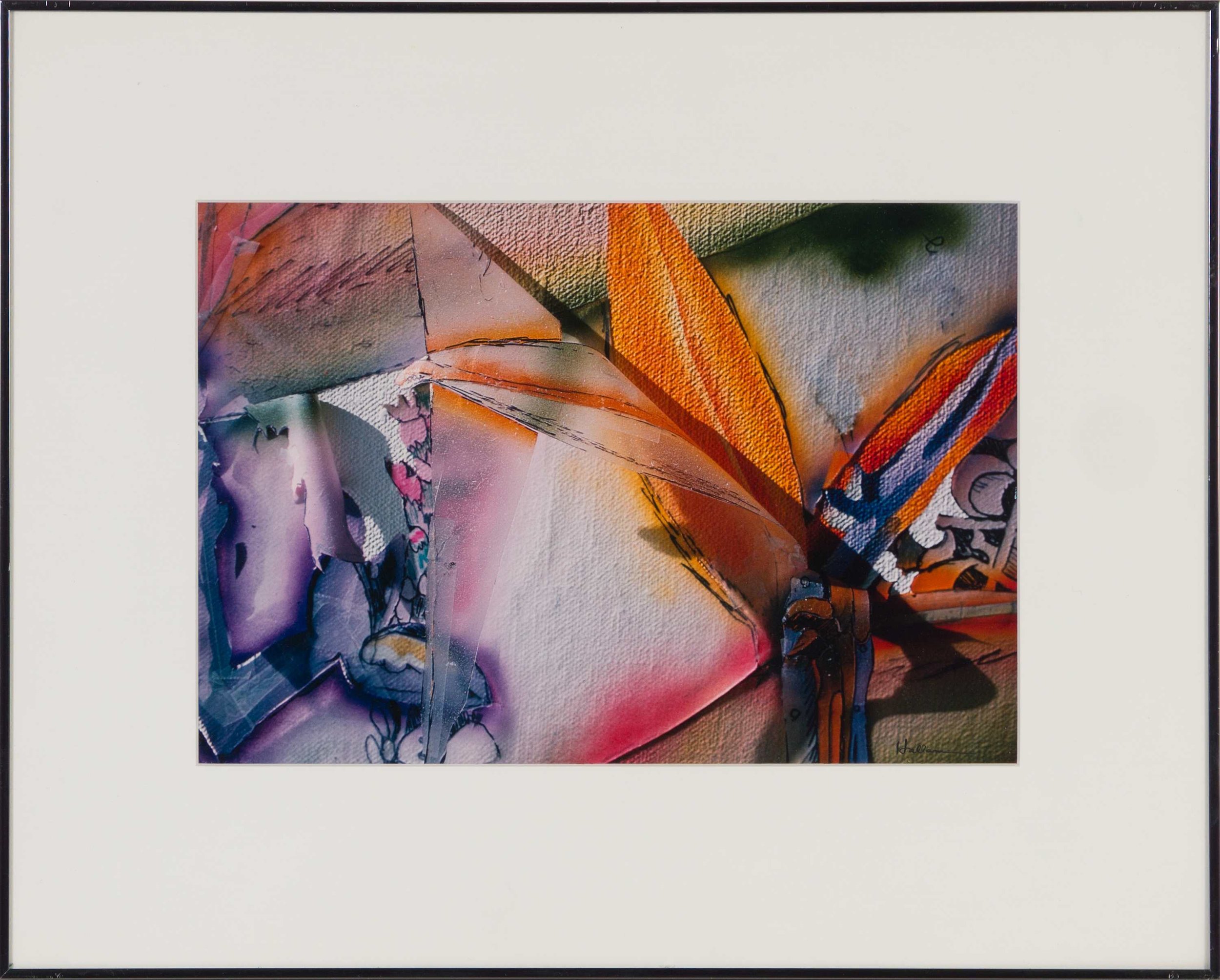
Surf Point is pleased to make available for sale from its visual archives three vintage Cibachrome prints of Birds of Paradise I, which is included in the exhibition Beverly Hallam: Chasing Light. Each edition was made and signed by Beverly Hallam during her lifetime. The works are priced at $2,500, unframed.
Beverly Hallam
Birds of Paradise I
9.5 x 14 in
Cibachrome
Limited edition of 20.
Editions available:
6/20
8/20
9/20
Contact us with any questions. We can arrange in-person pickup in Portland or York, Maine or ship your piece for an additional fee.
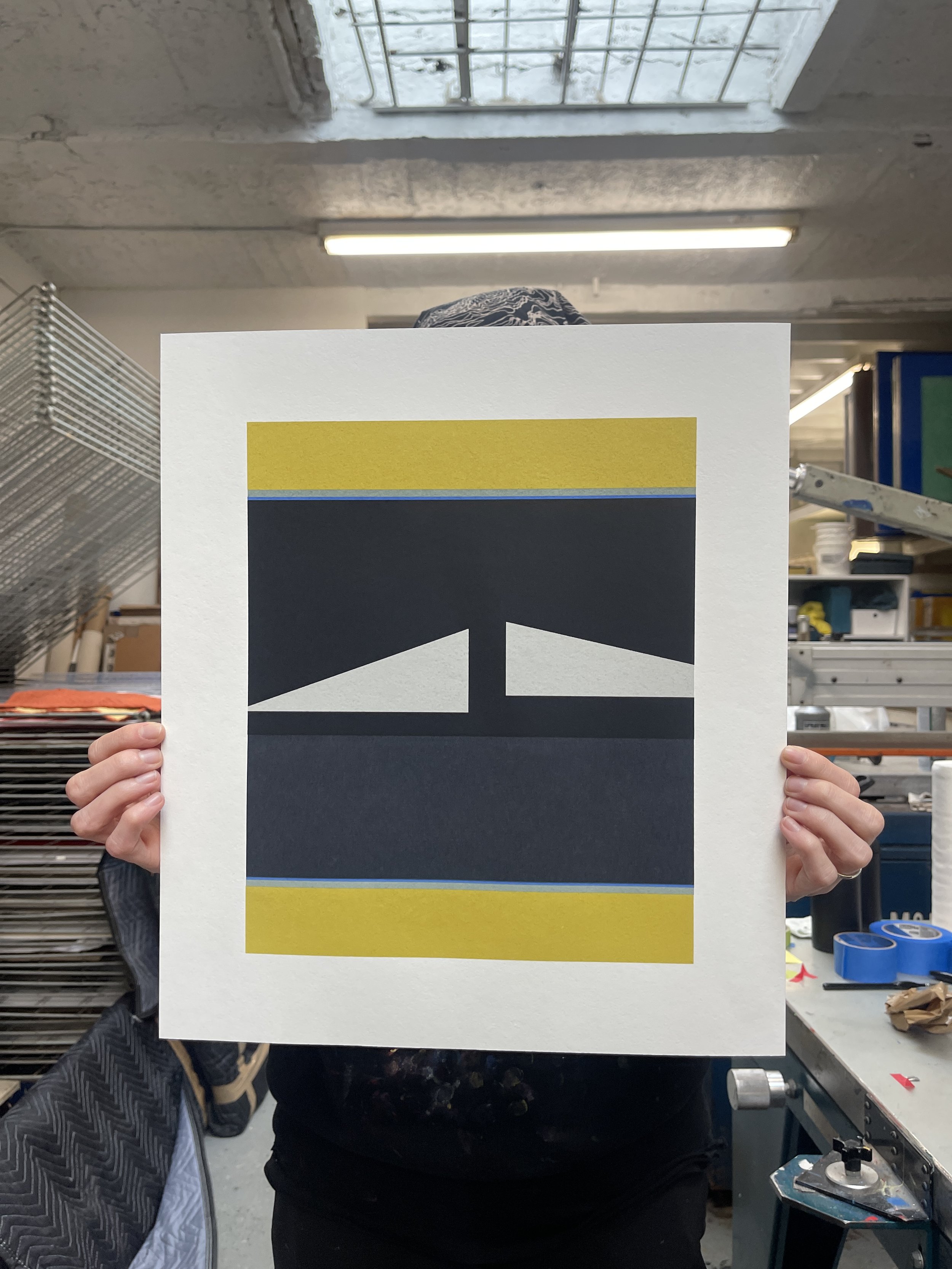
About the Print
Six color screen print on Rives BFK, 2023
Signed and numbered by the artist.
Image size: 12 x 10 in
Paper size: 16 x 14 in
Printed by Kingsland Printing, Brooklyn, NY.
Printed exclusively for Surf Point Foundation's fundraising print program.
About the Edition
“In my earliest paintings, the imagery I used derived from floor plans of places I lived or worked in. During my residency at Surf Point, I was able to study the original architectural drawings and plans of the building which gave me various new shapes and angles I could work with. The forms in “Clerestory” come from a selection of diagrams and notations I gleaned from the blueprints. There is no actual nave in the Surf Point building, and my print does not represent any real part of the building; it is meant to be evocative or have a suggestion of place. Rather than looking at the floor plans, this time, my interest was in the particulars to be found in the elevations. It was interesting to go back to a way of working that I had not engaged with for quite a few years and approach it from a different angle.” -Don Voisine ’22
About Don Voisine
Don Voisine, born in Fort Kent, ME in 1952, attended the Portland School of Art, now the Maine College of Art, and Concept School for Visual Studies in Portland, ME. Voisine was awarded a New York Foundation for the Arts painting grant in 2006 and has received purchase awards from the American Academy of Arts & Letters, The National Academy of Design, and the Portland Museum of Art. Fellowships and residencies include the Edward Albee Foundation Montauk, NY; The BAU Institute, Otranto, Italy; the Sharpe Walentas Studio Program, Brooklyn, NY; and the Surf Point Foundation, York, ME. His work has been reviewed in Art in America, Art News,The New York Times, The Washington Post, The New Criterion, Village Voice, Hyperallergic, and The Brooklyn Rail.

iliana emilia García "Sittings at Surf Point I" (2022). Monoprint on paper, 30 x 22 in.
At the core of my work is a poetic and emotional examination of the history of objects. I explore the value we assign to what we own from the places we come from and that which we keep through life’s journeys and crossroads. In my installations and paintings, there is an emphasis on the recurrence of objects telling evolving stories of resilience, and memory. I visually document things that may trigger and build up memory. I search for linkages of objects to places and emotions to convert them into storytellers in their own right. The presence of domestic objects, such as the chair, allows me to delve deeper into ancestral processes of survival, legacy, as well as dynamics between generations and places. The chair and text become instruments to relate to tradition, visual history as storytelling, remembrance, and commitment. I articulate the objects to recollect, preserve and reveal memory while reflecting on our basic need for emotional comfort. On canvas and in installations, my compositions emanate mappings of ancestry and personal history. They speak of human movements, migration, and constant evolution. They offer piles of stories to add to our present and create a chain of events, documentation, and intergenerational dynamics. They make us aware of the pockets of resilience among trauma and grief, and solidarity amid injustices. I may not change history, but I learn from it as the past of a present. - iliana emilia García ‘22
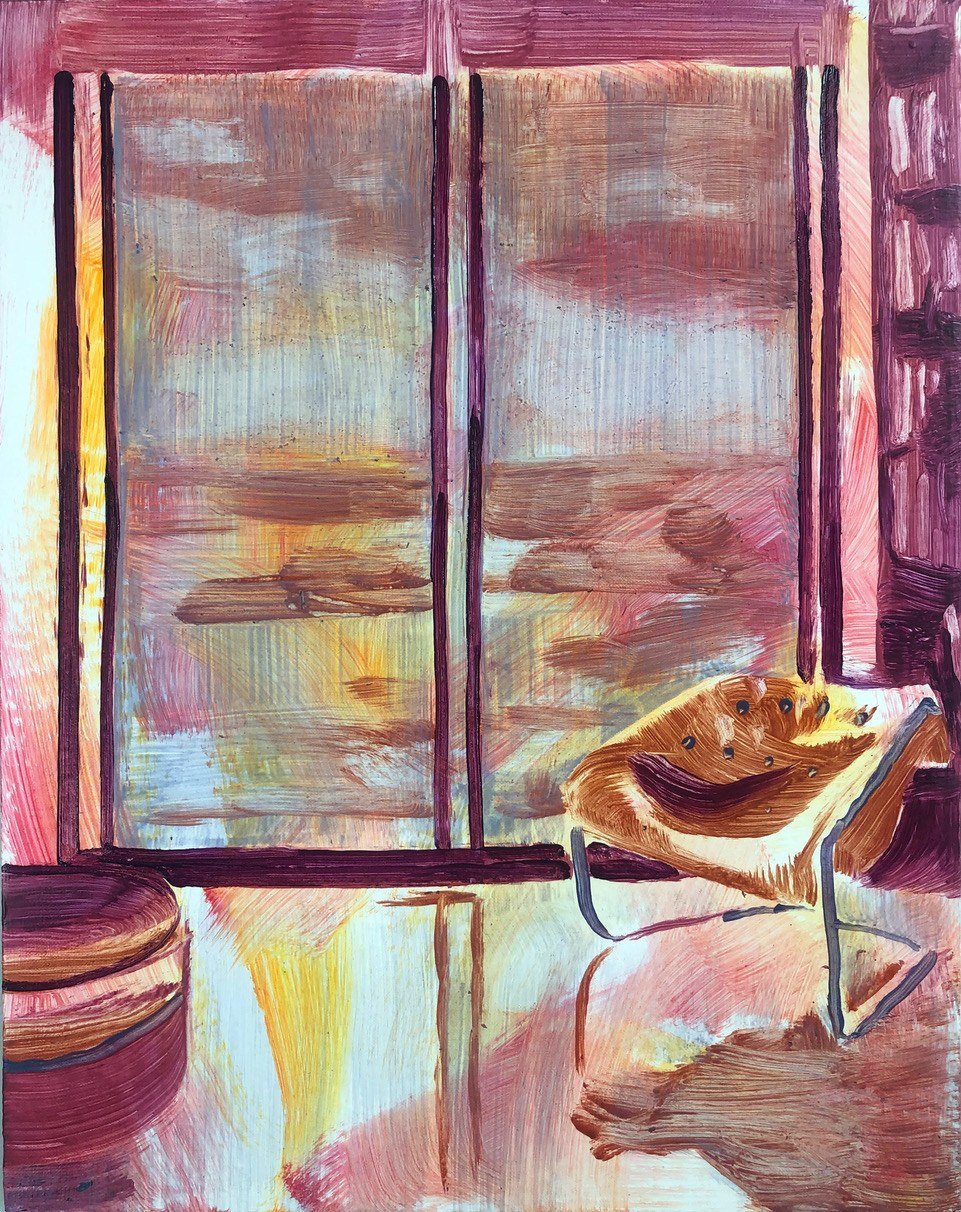
Tessa Greene O'Brien "Surf Point Chair" (2022). Oil on linen, 21 x 17 in.
I view painting as a framework through which I can deepen my understanding of my life and of the world around me. My painting practice prompts me to look slowly and closely at the details of the places I inhabit, and to give attention to the energy and characteristics of the people around me. While I root my practice in observation & storytelling, I often look towards abstract painting processes, freely borrowing techniques such as pouring, staining, dying, and scraping to achieve my visual aims. I consider myself a lifelong student on the history of painting, always leaving room in the studio for play, experimentation, and discovery.
Currently I am working primarily in oil, and alternating between traditional oil ground preparations on linen and a starting surface of colorful dyed canvas. Each technique presents unique ways to amplify light and color, and I am interested in how a strong sense of light and color have the potential to create an emotional experience for the viewer by adding a layer of storytelling to otherwise mundane depictions of daily life. The moments that I choose to paint are familiar to me, diaristic snapshots imbued with a color-induced layer of mystery or magic. I recall how places appear in dreams or memory, with spotty details, hazy blurs, or sharp contrast, and ask myself how I might make the paint act as such.
My paintings range in scale from postcard sized to large-scale murals, and these dramatic scale shifts affect my approach to painting-making. By regularly changing the studio parameters for myself, I strive to keep discovering new ways to connect with the viewer and to satisfy my own eyeballs. I am perpetually interested in the possibilities of paint as a medium of communication, contemplation, and invention. - Tessa Greene O’Brien ‘22
Attribution: Courtesy Dowling Walsh Gallery
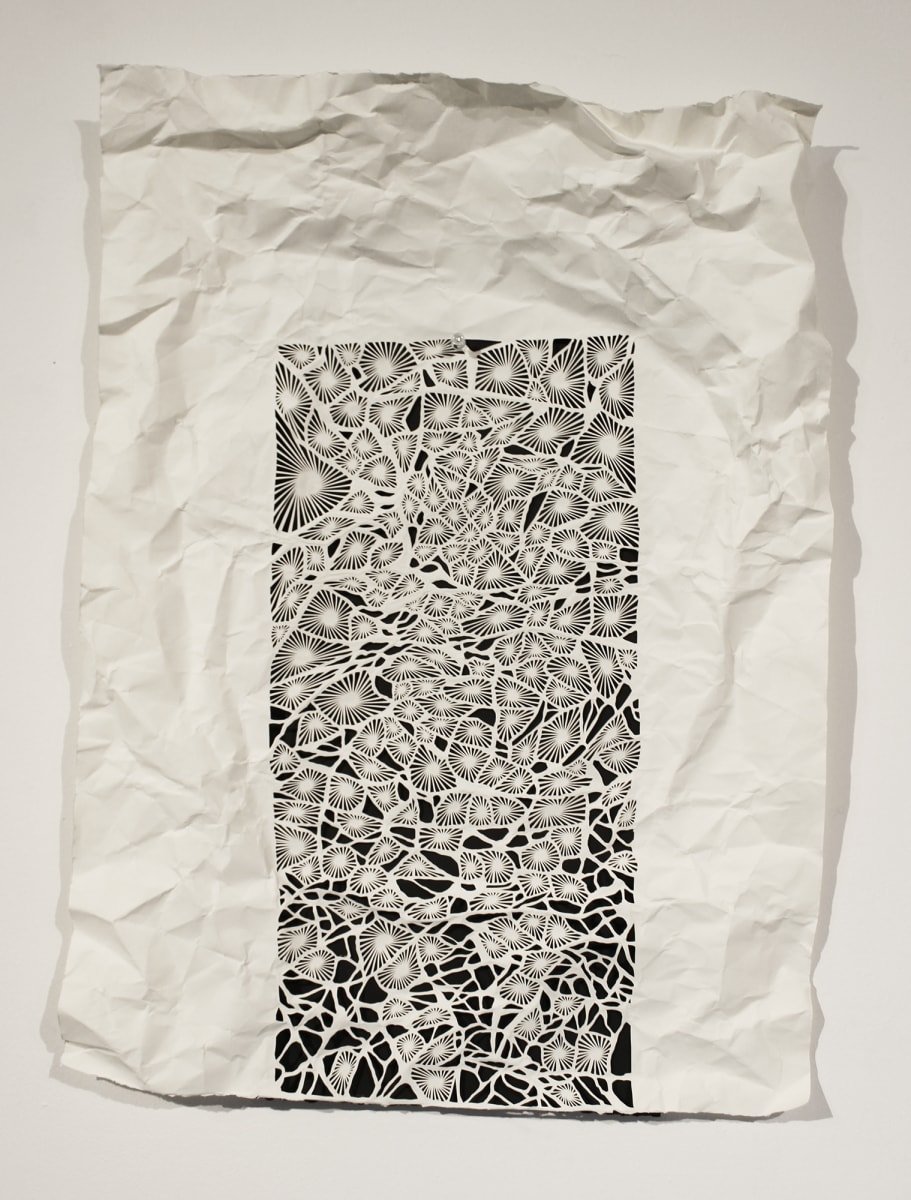
Isaac Jaegerman "Stele" (2019). Cut, crumpled paper 28.5 x 21.5 in. Framed.
This work is a contemplation on permanence, erosion, and decay. My role in making the work was to become an erosive force, slowly cutting away slivers of paper, following the existing geometry of wrinkles and creases in the crumpled sheet to remove material in the central rectangular space. The remaining image reminds me of a stele, or maybe a druidic slab, whose meaning and purpose has been forgotten over time. I like to think of artwork from this decontextualized lens of the future and imagine how it will be interpreted should it outlive me and my intentions. - Isaac Jaegerman ‘21
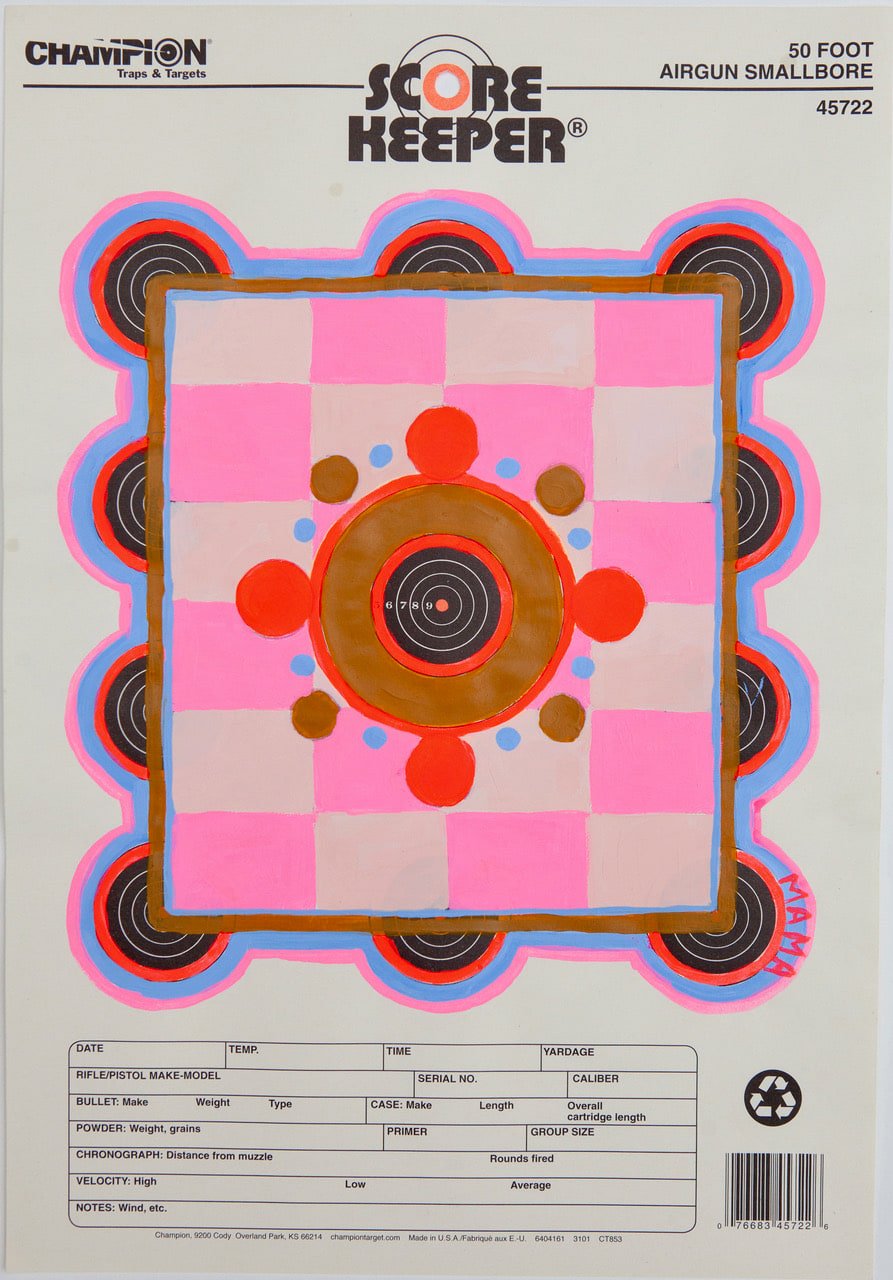
Crystalle Lacouture "MAMA Drawing #50" (2022). Gouache and colored pencil on Score Keeper shooting target 17 x 11 in. Framed.
Crystalle Lacouture is an artist whose works use symbols to represent care and thoughtful transmissions of power to others. Often her systems-based projects focus on marking time and the notion that the artist has a unique role as helper and gift-maker. Lacouture works across the media of painting, drawing, and printmaking to explore ideas of feminism, motherhood, portable memories, and the devotional, often using diaristic, durational, or communally-oriented practices. Her recently launched mail art initiative to create a crowdsourced repository of the popular songs passed down through generations can be found at lullabyarchive.com. She is represented by Praise Shadows Gallery in Boston.
Her time as a resident at Surf Point in April 2021 had a profound and lasting impact on her current body of work. She credits the immersive time to explore, ruminate, and research in a place of profound beauty and history to be a turning point in her practice. The greatest gift for an artist is time. - Crystalle Lacouture ‘21

Antonio McAfee "Crackling 1" (2021). Archival photographic print, 3D image with glasses 20 x 16 in. Framed.
Operating with photography, video, sculpture, drawing, and collage, Antonio McAfee’s work addresses the complexity of representation. Through appropriating and manipulating historical portraits, he engages in prescribed views of individuals and reworks images to provide an alternate, more layered image and concept of the people depicted. His photographs oscillate between formal considerations (modifying the print’s surface) and imaginary potential (establishing new backstories and roles) of the photographed sitter.
Throughout all McAfee’s work, the primary concern is to depict visual and physical transformation, in which the superficial read of him and others are abstracted to render it unstable. This is an attempt to encourage a layered and tangled relationship with whom and what is visually offered. One way he addresses prescribed assumptions is to use historical narratives and portraits. Through using appropriating sources, there is a basis for understanding particular ideas and stories that are passed down and sustained.
The main source of the artist’s portraits are family members that transitioned, funk icons, and studio portraits of middle-class African Americans from The Exhibition of American Negroes organized by W.E.B. Du Bois, Thomas Calloway, and Historic Black Colleges for the 1900 Paris International Exposition. The exhibition was a photographic, economic, and legislative survey of middle-class blacks in Georgia. Discussing her strong feelings for a photographic portrait of a Native American family, Lucy Lippard presents the phrase ‘intersubjective time’. Despite all the differences between the family, photographer, and her - time (a century), ethnicity, gender, class, etc. - she was able to develop a personal connection to the family that was rooted in how they were depicted. This urged her to conduct further research, which informed her of the specifics of their lives. Similarly, Antonio creates work that rests in the past, gets filtered through his experiences and artistic practice, and is shared to an audience to offer something anew. - Antonio McAfee ‘22
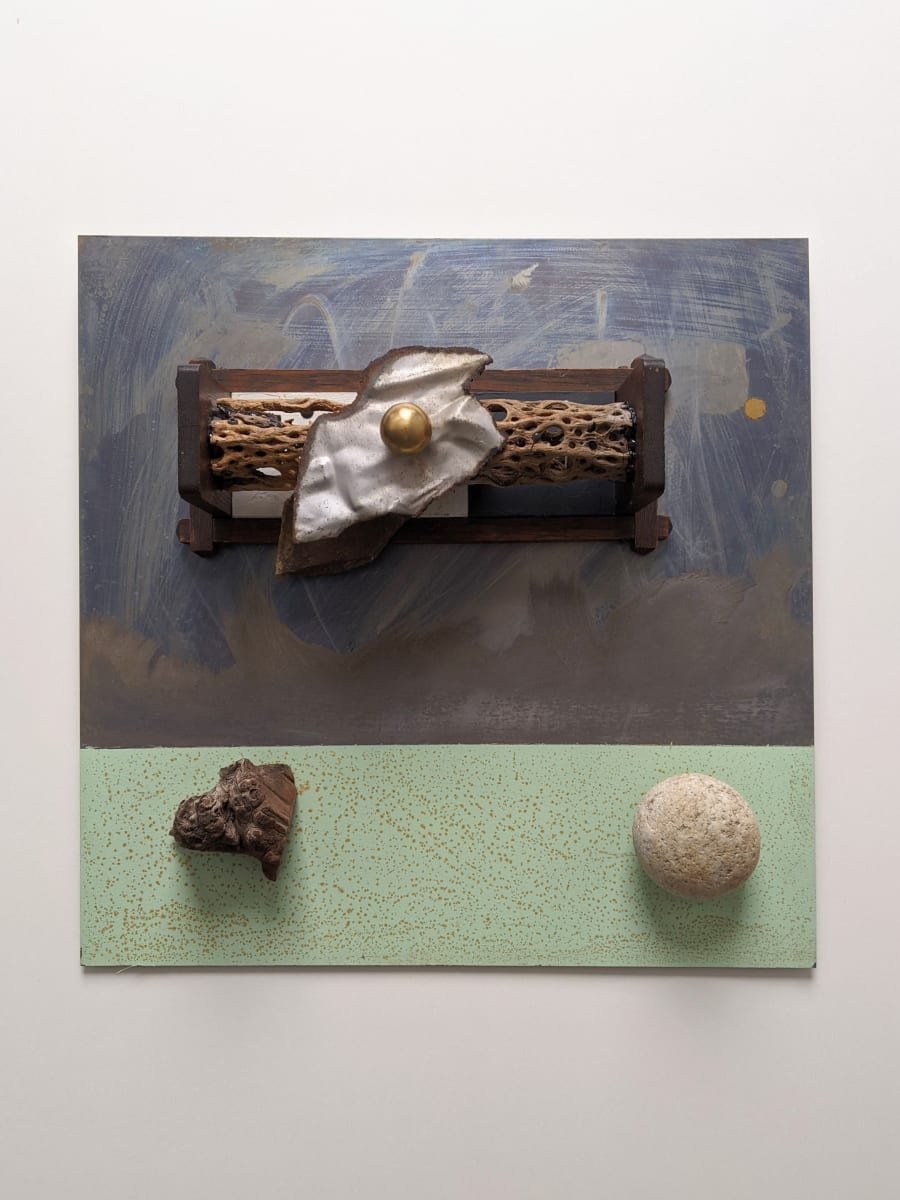
Tyrone Mitchell "Gulf Stream (After Winslow Homer)" (2023). Found objects, painted steel. 24 x 24 x 9 in.

Lisi Raskin "For Araeen, 5" (2019). Gouache, graphite, nerve pain on woven paper 4.25 x 4 in.
For the last decade, I have been practicing ways of being that embrace what I now understand to have always been my trans and disabled embodiment. I focus my energy on endeavors, including art making, that are responsive and accountable to the needs of my body and community. I am ever in search of co-conspirators whose lived practices are rooted in mutuality, reciprocity, radical love, and care. This piece in particular is dedicated to Rasheed Araeen whose critical and creative work set a profound example of decompartmentalization. - Lisi Raskin ‘21

Daniela Rivera "Returning Home" (2022). Photography and drawing on paper, 24 x 36 in. Framed.
I am a part and symptom of blurry cultural boundaries, performing on a stage of vernacular cannibalizations. I consider my responsibility to always challenge the construction of stereotypes or categories that discriminate, isolate and violently define the identities of others. I work as an artist with ideas of displacement, memory, and cultural migration to celebrate difference and reject categorization. I build, paint, and draw spaces that invite us to be vulnerable together, where I hope to celebrate difference and cultural exchange through shared authorship. I focus my attention on the migration of cultural objects, narratives, practices, and myths. I address episodes in political history, the history of art and personal history to generate open-ended conversations among viewer, artist and subject. The relation between these three players creates the work. I am invested in generating projects that leave space for the public to intervene, sharing in the construction of the meaning of the piece. I have found that surrendering authorship allows for responsible collaboration and active reflection.
Drawing as understanding, drawing as seeing, drawing as analysis and drawing as a mode of engagement is at the center of my practice. Lately I have been working on monumental scale material drawings that allow the public to participate in mark making, extending the active life of the drawing. - Daniela Rivera ‘21
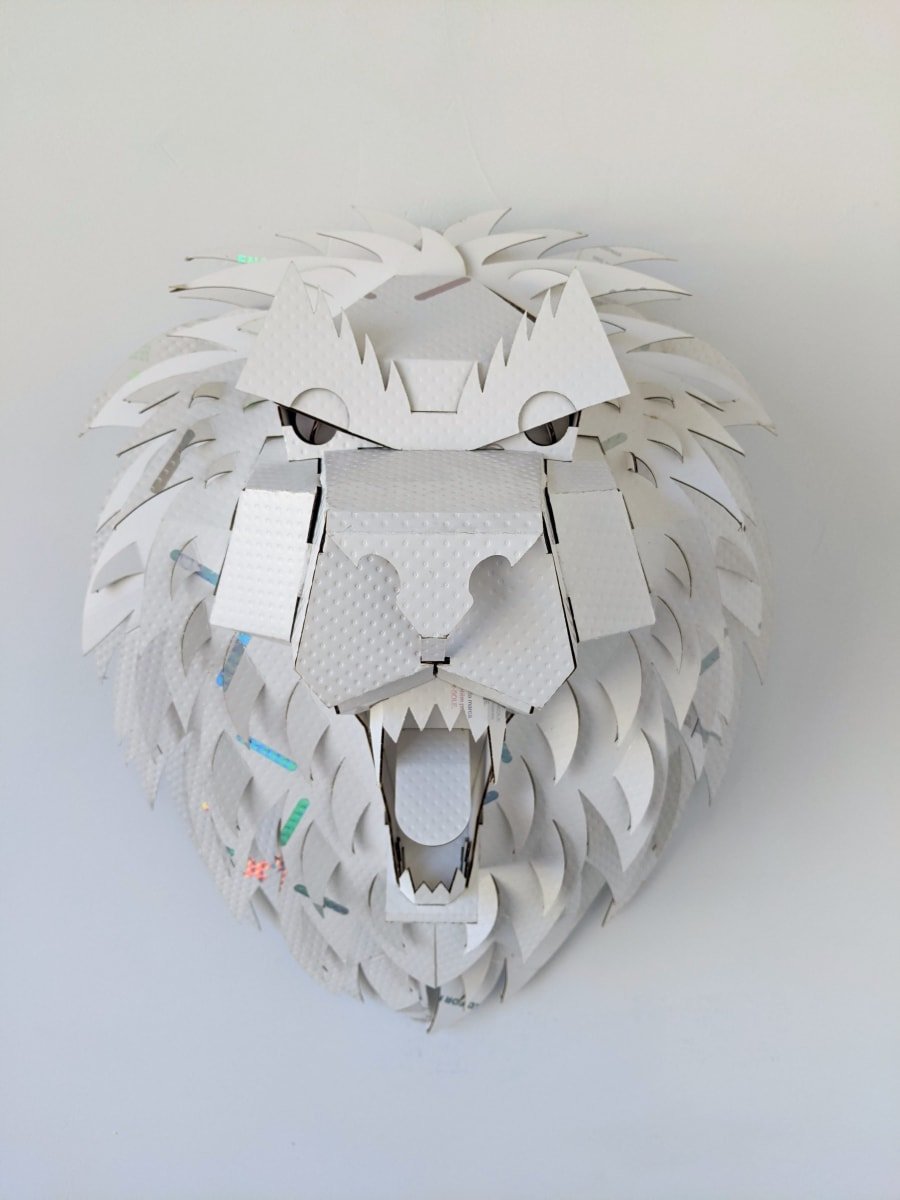
Christophe Roberts, "MANZA PROTOTYPE 2" (2021). Upcycled from waste shoe boxes, 20 x 14 x 10 in.
When creating the Manza: DIY, Christophe went through countless prototypes before landing on the final product. Christophe wanted a way to teach artists about the process behind his sculptures made from waste. Drawing from the same methods that have brought the artist global recognition, Afrogami is a culmination of influences that have shaped Christophe’s work—his Bahamian roots and the island’s legacy of craftsmanship, African masks, and folklore, the Japanese art of origami, a fascination with sneaker culture and his Chicago upbringing. The result is a sustainable sculpting technique that takes shape through folds and self-locking pins, requiring no glue or chemical adhesives. The Manza: Prototype is a limited edition using shoe boxes to test out the process before he was able to create his own product and finally release the Manza: DIY. - Christophe Roberts ‘22
Silver reflective Surf Point stickers for your car, water bottle, tech, art supplies, or whatever you may choose!
Available in two different styles: the Classic Surf Point logo, and the wavy Surf Point logo designed by co-founder Beverly Hallam.