
James Eric Francis Sr., February - March 2026
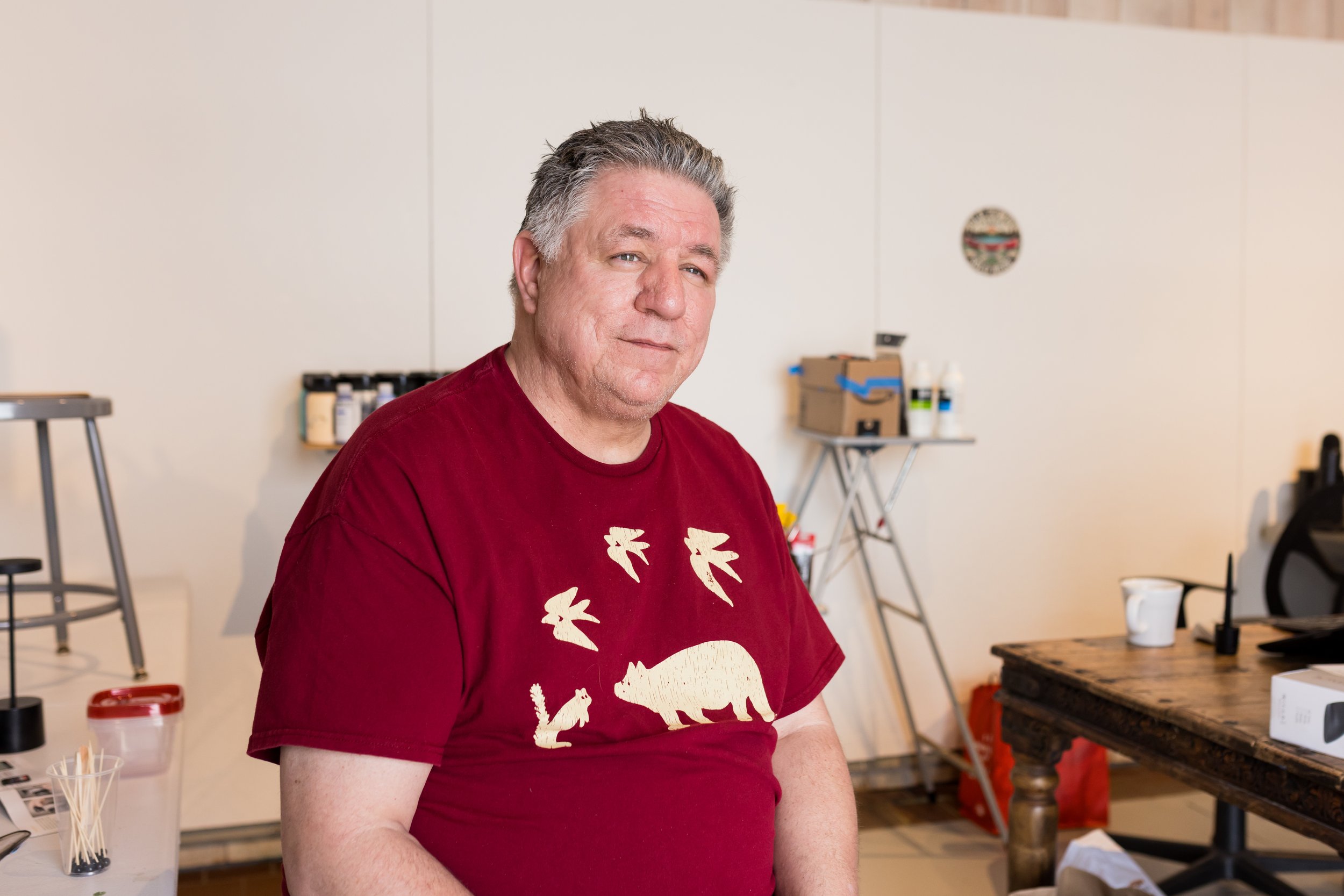
James Eric Francis Sr. in the Pool Room Studio. Photo by Kerry Constantino.
James Eric Francis Sr., a member of the Penobscot Nation, is a multifaceted artist whose work is deeply intertwined with his roles as a historian, cultural preservationist, and tribal leader. His art, which includes painting, photography, filmmaking, and graphic design, is a powerful exploration of the relationship between Maine Native Americans and the landscape, viewed through an indigenous lens.
As a visual artist, Francis creates work that is both historical and deeply personal. He often uses his art to challenge dominant historical narratives and to assert the resilience and continued presence of the Penobscot people. A prime example is his painting "We Walk On; Eternally," where he recreates a genocidal 1755 proclamation from Massachusetts Lieutenant Governor Spencer Phips calling for the extermination of the Penobscot people. Across this document, he stamps in blood-red letters the Penobscot word for "we walk on; eternally," a powerful statement of survival and a plea for a new, respectful relationship with the people of Maine.
Francis's painting often incorporates intricate techniques, such as his dot paintings, which he began after being inspired by the methodical process of flint knapping. These paintings, such as "Welcome Home," pay homage to the natural world and Penobscot traditions, often celebrating the return of salmon to the Penobscot River. His work also delves into Penobscot legends and cosmology, as seen in his painting "The Great Penetrating Arrow," which tells the story of how all animals and people sprang from an ash tree shot by the hero Gluskabe. This piece, like much of his art, emphasizes the Penobscot belief that humans are on the same plane as all other living creatures.
His artistic practice extends to photography, filmmaking, and graphics. He co-produced the documentary *Invisible*, which examines racism faced by Native Americans in Maine and the Canadian Maritimes. His photography often takes the form of time-lapses, capturing the beauty of the Maine landscape—from the Penobscot River to Mount Katahdin—and its connection to his ancestors. Francis’s work as a graphic artist and filmmaker further supports his mission to revitalize and preserve Penobscot culture, with his oral history projects bringing to life historical pictures and community stories.
In addition to his creative work, Francis is a renowned curator. He has curated exhibits on Penobscot history at institutions such as the Bangor Museum and Center for History, the Abbe Museum, and Harvard University. His curatorial work, like his art, aims to "re-indigenize" historical landscapes and challenge the absence of Native American narratives in historical depictions.
Francis is working on a graduate degree of the University of Maine's Intermedia Masters of Fine Arts program, and his work as an artist is inextricably linked to his lifelong commitment to cultural preservation and education. He serves as the Director of Cultural and Historic Preservation and Tribal Historian for the Penobscot Nation and is a co-founder and Chair of Local Contexts, an initiative to help Indigenous communities manage their cultural heritage and intellectual property. Through his art and his many professional roles, James Eric Francis Sr. provides a unique and vital perspective on history, place, and the enduring power of Indigenous culture.
Visit Francis’s Instagram page here.